Dithered Beamforming for Channel Estimation in Mmwave-Based Massive Mimo
Abstract
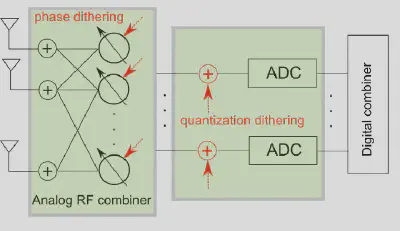
In this work we consider the challenging problem of chan- nel estimation at the receiver of a massive multiple-input multiple-output system with hybrid analog/digital beamform- ing and low-resolution quantization. We propose a dithered beamforming architecture, where random control signals are injected to the analog part of the receiver beamformer and to the analog-to-digital converters to introduce randomness into the signal capturing process and combat the stair-case quanti- zation effects. The statistical properties of the dithered output are captured via an Expectation-Maximization approximation of the maximum a-posteriori estimator. A low-complexity al- gorithm is proposed which exhibits performance close to the oracle-based least-squares estimation of the sparse channel.
Key Contributions
- Proposed a dithered beamforming architecture by injecting random control signals into the analog beamformer and ADCs to combat quantization effects.
- Developed a low-complexity Expectation-Maximization algorithm for sparse channel estimation in hybrid beamforming systems with low-resolution ADCs.
- Demonstrated that the technique effectively mitigates quantization non-linearities and improves channel estimation performance in mmWave massive MIMO systems.